
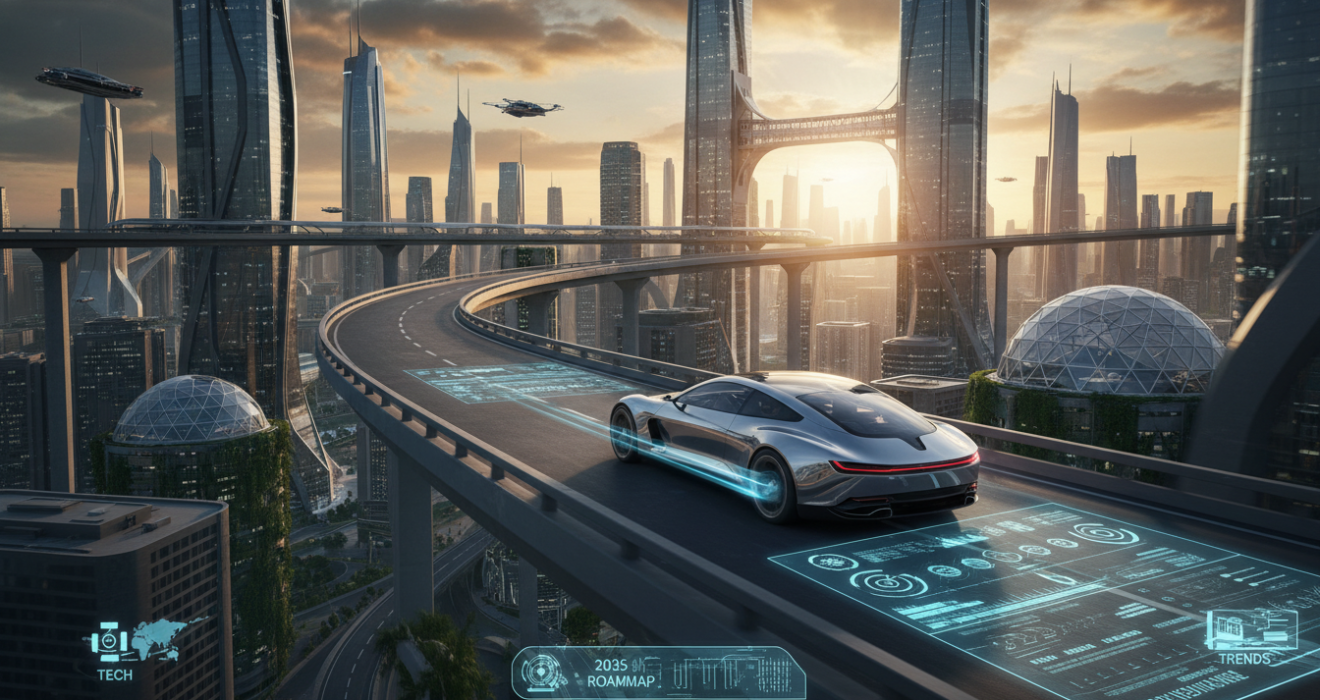
The Future of Automobiles: Tech, Trends & 2035 Roadmap
The Future of Automobiles: A Roadmap to 2035 and Beyond
In my two decades covering the automotive industry, I have witnessed shifts from carburetors to fuel injectors and from sedans to SUVs. However, nothing compares to the seismic transformation we are currently undergoing. The future of automobiles is not merely about changing the powertrain from gasoline to electric; it is a fundamental reimagining of what a vehicle is, how it functions, and how it integrates into the fabric of our lives. Consequently, we are standing on the precipice of a revolution that blends robotics, artificial intelligence, and sustainable energy into a singular mobility experience.
Furthermore, this shift is driven by a convergence of technological breakthroughs and changing consumer expectations. We are moving away from the era of horsepower wars and into the age of computing power wars. In this comprehensive guide, I will dissect the critical pillars supporting the next generation of transport. From the promise of solid-state batteries to the ethical dilemmas of autonomous algorithms, we will explore every facet of this complex evolution.
Executive Summary: Key Trends Shaping the Future of Automobiles
To provide a quick overview before diving deep, the following table summarizes the primary drivers of change in the automotive sector over the next decade.
| Core Trend | Projected Impact | Timeline to Maturity |
|---|---|---|
| Electrification (EVs) | Total replacement of ICE vehicles in major markets; reduced carbon emissions. | 2030-2035 |
| Autonomous Driving | Shift from driver-centric to passenger-centric experiences; potential elimination of traffic accidents. | 2028-2040 |
| Software-Defined Vehicles (SDVs) | Cars receiving OTA updates like smartphones; recurring revenue models for OEMs. | 2025-2030 |
| Connectivity (V2X) | Vehicles communicating with infrastructure, pedestrians, and other cars to optimize flow. | 2026-2032 |
| Sustainable Manufacturing | Circular economy implementation; green steel and battery recycling. | 2025-2035 |
Electrification: The Heart of the Future of Automobiles
Undoubtedly, the most immediate and visible change in the future of automobiles is the mass transition to electric propulsion. While early electric vehicles (EVs) were plagued by range anxiety and slow charging speeds, the next generation promises to obliterate these hurdles. My experience driving the latest prototypes suggests that we are approaching a tipping point where EVs will not only match internal combustion engines (ICE) in convenience but surpass them.
Beyond Lithium-Ion: The Rise of Solid-State Batteries
Currently, the industry relies heavily on liquid electrolyte lithium-ion batteries. However, these are reaching their theoretical energy density limits. Consequently, the industry is pivoting toward solid-state batteries. These batteries replace the liquid electrolyte with a solid material, which significantly improves safety and energy density. In addition, solid-state technology promises to double the range of current EVs while cutting charging times to under 15 minutes.
Moreover, major manufacturers are racing to commercialize this technology. We are seeing pilot production lines being established, and by 2028, we expect to see flagship models sporting this technology. This advancement is critical because it addresses the two biggest consumer pain points: range and charging speed. Once a car can charge as fast as it takes to fill a gas tank, the argument for ICE vehicles largely evaporates.
Infrastructure Challenges and Smart Grids
Furthermore, the future of automobiles is inextricably checking the health of our energy grids. As millions of EVs plug in simultaneously, the demand on the grid will be immense. To manage this, Vehicle-to-Grid (V2G) technology is being developed. This allows cars to push energy back into the grid during peak hours and charge during off-peak hours. According to the International Energy Agency (IEA), smart charging could be the key to balancing renewable energy intermittency.
In addition to V2G, we are seeing the rollout of megawatt charging systems (MCS) designed for heavy-duty trucks, which will eventually trickle down to passenger vehicles. The charging experience itself is becoming seamless, with “plug and charge” protocols eliminating the need for apps and credit card swipes. You simply plug in, and the car communicates with the charger to handle billing automatically.
Autonomous Driving: When Will Cars Drive Themselves?
While electrification changes how cars move, autonomous driving changes who—or what—moves them. The pursuit of self-driving technology is perhaps the most ambitious aspect of the future of automobiles. However, the timeline has shifted from optimistic predictions of “robotaxis everywhere by 2020” to a more pragmatic, safety-first approach.
The 5 Levels of Autonomy
To understand where we are going, we must look at the classification of automation standard established by the SAE International. Most modern cars operate at Level 2, where the driver must remain engaged. Level 3, which allows eyes-off driving in specific conditions, is just entering the market. The holy grail is Level 5—full automation under all conditions.
- Level 1 (Driver Assistance): Adaptive cruise control.
- Level 2 (Partial Automation): Lane centering and acceleration.
- Level 3 (Conditional Automation): The car drives, but the human must intervene if requested.
- Level 4 (High Automation): No human intervention needed in geofenced areas.
- Level 5 (Full Automation): The steering wheel is optional.
Consequently, the leap from Level 2 to Level 3 is massive due to liability shifts. At Level 3, the manufacturer accepts liability when the system is engaged. This legal reality has made automakers cautious. Nevertheless, looking ahead to the future of automobiles, we anticipate Level 4 robotaxi fleets becoming common in major urban centers by 2030.
Sensor Fusion: LiDAR vs. Vision
Furthermore, a technological war is waging regarding the sensors required for autonomy. One camp argues that cameras combined with AI (Vision-only) are sufficient, mimicking human sight. The opposing camp insists on LiDAR (Light Detection and Ranging) to create precise 3D maps of the environment. In my analysis, a redundant system employing Radar, LiDAR, and Cameras offers the highest safety margin. As sensor costs plummet, we will likely see this “sensor fusion” approach dominate the market.
Software-Defined Vehicles (SDVs): The Next Frontier
Historically, a car was a hardware product. You bought it, and it depreciated the moment you drove off the lot. However, the future of automobiles redefines the car as a software platform. This concept, known as the Software-Defined Vehicle (SDV), means that the vehicle’s functionality is primarily enabled and managed by software.
Over-the-Air (OTA) Updates
Just as your smartphone receives updates that improve battery life or add new features, SDVs will improve over time. I have personally experienced vehicles that gained increased acceleration and better braking capability solely through an overnight software download. Consequently, this extends the lifecycle of the vehicle and helps maintain its residual value.
Moreover, this shift allows for “Functions on Demand.” Imagine you are planning a road trip and need advanced autopilot features or heated seats for just one month. In the future, you will be able to subscribe to these features digitally. While this subscription model has faced consumer backlash, it is undeniably a major part of the automotive business strategy moving forward.
The Digital Cockpit and User Experience
Inside the cabin, physical buttons are disappearing, replaced by massive hyperscreens and voice assistants powered by Generative AI. The car is becoming a third living space. Integration with our digital lives is becoming absolute. For those looking to enhance their daily routines during these commutes, platforms like BlissLifes offer resources on integrating wellness into every aspect of life, including travel. As cars take over the driving task, the focus shifts to passenger wellness, entertainment, and productivity, aligning perfectly with a lifestyle-centric approach.
Sustainability in the Future of Automobiles
Sustainability extends far beyond the tailpipe. A truly green future of automobiles requires a holistic approach to manufacturing and materials. We are seeing a move toward the “Circular Car,” which is designed to be disassembled and recycled at the end of its life.
Green Steel and Vegan Interiors
Automakers are increasingly sourcing “green steel,” produced using hydrogen rather than coal, to reduce the embedded carbon in the vehicle’s chassis. Furthermore, interiors are shedding leather in favor of mycelium (mushroom-based) leathers, recycled PET plastics, and bamboo. These materials not only reduce the carbon footprint but also offer a modern, premium aesthetic that appeals to eco-conscious buyers.
Battery Recycling and Second Life
Additionally, the issue of battery disposal is being addressed through robust recycling programs. When an EV battery degrades to 70% capacity, it is no longer suitable for a car, but it is perfect for stationary energy storage. These “second-life” batteries are being used to power homes and stabilize grids. Eventually, up to 95% of the critical minerals like cobalt, nickel, and lithium can be recovered and used to manufacture new batteries, creating a closed-loop ecosystem.
Safety Innovations: Protecting Passengers in the Future
Despite all the technology, safety remains paramount. The future of automobiles targets a vision of “Zero Accidents.” While autonomy is the ultimate solution, intermediate technologies are making cars safer today.
Predictive AI and V2X Communication
Vehicle-to-Everything (V2X) communication allows cars to “talk” to traffic lights, other cars, and even pedestrians’ smartphones. If a car two blocks ahead slams on its brakes, your car will know instantly, long before you can see brake lights. According to the National Highway Traffic Safety Administration (NHTSA), V2V and V2X technologies have the potential to prevent or mitigate up to 80% of non-impaired crashes.
In addition, internal monitoring systems are becoming mandatory. Cameras analyze the driver’s gaze and head position to detect distraction or drowsiness. If the system detects an incapacitated driver, the car can safely pull over and call emergency services. This feature alone will save thousands of lives annually.
Urban Mobility and the Shift in Car Ownership
The traditional model of one person, one car is becoming unsustainable in dense urban environments. The future of automobiles in cities is likely to be shared rather than owned. This concept, known as Mobility as a Service (MaaS), integrates public transport, ride-hailing, and micro-mobility into a single accessible network.
The Rise of Robotaxis and Pods
Purpose-built vehicles, such as autonomous pods, are being designed specifically for ride-sharing. These vehicles lack a driver’s seat entirely, maximizing interior space for passengers. They are designed for durability and ease of cleaning, running 24/7 to serve urban populations. Consequently, the cost per mile of travel is expected to drop below the cost of personal car ownership, incentivizing city dwellers to ditch their private vehicles.
Micro-Mobility Integration
However, cars are not the solution for every journey. For the “last mile,” electric scooters and e-bikes are often faster and more efficient. Future automobiles may come equipped with docking stations for these micro-mobility devices, or MaaS apps will seamlessly route you from a robotaxi to a scooter for the final leg of your journey.
Design Evolution: How the Future of Automobiles Looks
Without the constraints of a bulky internal combustion engine, drive shaft, and transmission tunnel, designers are free to reinvent the vehicle’s form factor. This freedom is leading to the “skateboard” architecture, where all mechanical components are housed in the flat floor of the vehicle.
Interior as a Living Space
This architecture allows for a flat floor and a spacious, lounge-like cabin. Front seats can swivel to face the rear, creating a social environment. Concepts for the future of automobiles often feature retractable steering wheels and ambient lighting that adjusts to the passengers’ mood. The distinction between a car and a mobile living room is blurring.
Aerodynamics and Efficiency
Externally, the focus is on aerodynamics to maximize EV range. We are seeing active aero elements that change shape at speed, digital side mirrors (replacing drag-inducing glass mirrors), and smooth, tear-drop shapes. While some enthusiasts lament the loss of traditional grilles, the new aesthetic is undeniably futuristic and functional.
Challenges and Ethical Considerations
Despite the optimism, significant hurdles remain. Cybersecurity is a massive concern. As cars become connected computers, they become targets for hackers. A compromised fleet of autonomous vehicles could be weaponized, making cybersecurity a matter of national defense.
Furthermore, the “Trolley Problem” remains an ethical dilemma for AI developers. In an unavoidable accident, how does the algorithm decide between hitting a pedestrian or swerving into a wall and risking the passenger? These ethical frameworks must be standardized globally to ensure public trust in the future of automobiles.
Conclusion
The next two decades will transform personal mobility more than the previous century combined. The future of automobiles is electric, autonomous, connected, and software-defined. It promises safer roads, cleaner air, and more productive commute times. However, it also demands that we adapt our infrastructure, our laws, and our expectations.
As we transition from being drivers to being passengers, the car evolves from a machine of utility to a sanctuary of experience. Whether you are an enthusiast mourning the roar of a V8 or a tech-optimist awaiting your first robotaxi ride, one thing is certain: the road ahead is incredibly exciting. The key to navigating this future lies in embracing the technology while remaining vigilant about the ethical and practical challenges it presents.
Frequently Asked Questions (FAQ)
Will gasoline cars be banned in the future?
Many countries and states have announced bans on the sale of new internal combustion engine vehicles, typically taking effect between 2030 and 2035. However, existing gasoline cars will likely remain legal to drive for decades, though they may face higher taxes or restrictions in city centers.
Are self-driving cars safe?
Data suggests that autonomous systems, which do not get tired, drunk, or distracted, have the potential to be significantly safer than human drivers. However, during the transition period where human drivers and AI share the road, accidents will still occur, often garnering significant media attention.
How long will EV batteries last?
Modern EV batteries are designed to last the life of the vehicle, often exceeding 150,000 to 200,000 miles with minimal degradation. With the advent of solid-state batteries in the future of automobiles, lifespans are expected to increase further.
What happens to the power grid if everyone drives an EV?
While energy consumption will increase, grid operators are planning for this shift. Smart charging (charging at night) and Vehicle-to-Grid technology will actually help stabilize the grid by using parked EVs as battery storage buffers.
Will cars become more expensive?
Initially, new technology carries a premium. However, as battery prices fall and manufacturing scales, the cost of EVs is projected to reach parity with gas cars. Additionally, the lower cost of electricity and maintenance means the total cost of ownership is often lower.