
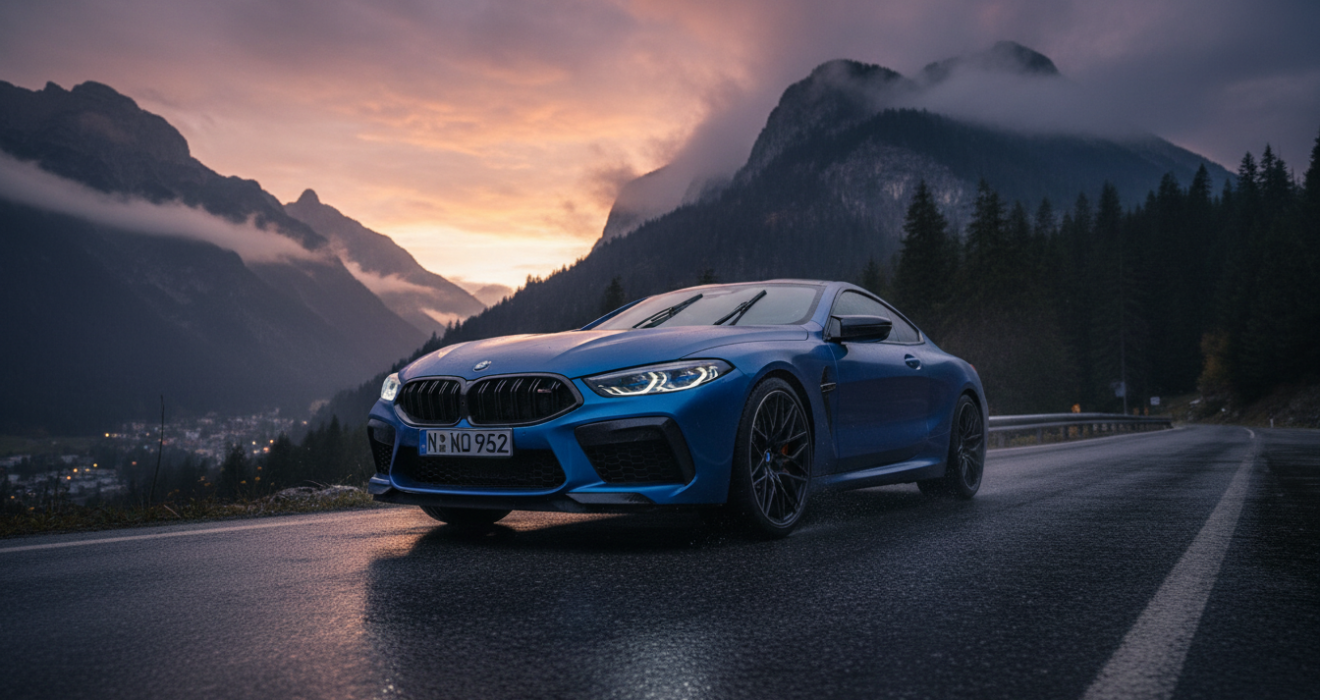
BMW M8 Deep Dive: Performance, Specs & Luxury Review
BMW M8 Deep Dive: The Apex of Bavarian Engineering
There is a specific moment, just as the tachometer sweeps past 4,000 RPM, where the BMW M8 transforms from a comfortable grand tourer into a physics-defying missile. As an automotive journalist who has spent decades analyzing the nuance of M-badged machinery, I can confidently state that few vehicles bridge the gap between luxury and violence as effectively as the 8 Series flagship. In this comprehensive BMW M8 Deep Dive, I will take you behind the wheel and under the hood to explore exactly what makes this machine a pinnacle of modern automotive engineering.
Consequently, we must look beyond the glossy brochure figures. While 617 horsepower is an impressive statistic, it does not fully convey the sensation of the M xDrive system clawing into the asphalt or the surprisingly supple ride quality in Comfort mode. Furthermore, understanding the lineage and the technological leaps taken by BMW’s M Division provides necessary context. Whether you are a prospective buyer or an enthusiast, this analysis aims to provide high-level information gain you won’t find in standard reviews.
Executive Summary: The M8 at a Glance
Before we embark on the full narrative, here is a quick reference guide to the vehicle’s core specifications. This table serves as a baseline for our subsequent analysis.
| Specification | Data Point |
|---|---|
| Engine Code | S63B44T4 (4.4L V8 Twin-Turbo) |
| Horsepower | 617 hp @ 6,000 rpm (Competition) |
| Torque | 553 lb-ft @ 1,800-5,860 rpm |
| 0-60 MPH | ~2.5 seconds (Real-world testing) |
| Transmission | 8-Speed M Steptronic |
| Drivetrain | M xDrive (AWD with 2WD mode) |
| Curb Weight | ~4,300 lbs (varies by body style) |
The Genesis of a Super GT
To truly appreciate the current iteration, one must look back at the history. The revival of the 8 Series was not merely a marketing exercise; specifically, it was a declaration of intent. The original E31 8 Series of the 1990s was a technological marvel, yet it never received a proper M variant production run (despite the legendary prototype). However, with the F91/F92/F93 generation, BMW finally delivered on a promise made decades ago. This vehicle was designed to sit at the very top of the food chain, combining the agility of the M5 with the presence of a dedicated luxury coupe.
Moreover, the market placement of the M8 is fascinating. It competes in a rarefied air occupied by the Bentley Continental GT, the Porsche 911 Turbo, and the Mercedes-AMG GT 63. Consequently, the engineers at Garching had to ensure the car could handle track abuse without punishing the driver on a cross-continental road trip. This duality is the central theme of our BMW M8 Deep Dive.
A Technical BMW M8 Deep Dive into the Engine Room
The heart of the beast is the S63 engine. This 4.4-liter, twin-turbocharged V8 is a masterpiece of thermal efficiency and raw power. Unlike traditional turbo setups, the S63 utilizes a “Hot-V” configuration. In this layout, the two twin-scroll turbochargers are positioned inside the V of the engine block rather than on the outside. As a result, the distance exhaust gases must travel to spin the turbine wheels is drastically reduced. Therefore, turbo lag is virtually eliminated, providing instantaneous throttle response.
Cooling and Lubrication
Furthermore, an engine generating this level of heat requires a robust cooling system. BMW M implemented a complex network of radiators and coolers. Specifically, there is an indirect charge air cooling system that keeps intake temperatures dense and oxygen-rich. During my time testing the vehicle at high ambient temperatures, I noticed the oil and water temperatures remained rock steady, even after repeated hard acceleration runs. This reliability is paramount for a car that claims track capability.
In addition to cooling, the oil supply system is designed for high lateral G-forces. The M8 features a map-controlled oil pump and a suction system that ensures the turbos and engine internals remain lubricated even when the car is cornering hard. For technical enthusiasts referencing data from BMW M GmbH, the engineering tolerances here are tighter than almost any other production V8 in their lineup.
Transmission Dynamics in the M8 Competition
Power is nothing without delivery. The 8-speed M Steptronic transmission with Drivelogic is, in my professional opinion, one of the finest torque-converter automatics in existence. It bridges the gap between the smoothness of a standard automatic and the snap of a dual-clutch transmission (DCT). Through the Drivelogic switch on the gear selector, the driver can adjust the shift ferocity.
Level 1 offers buttery smooth transitions for highway cruising. However, switch to Level 3, and the shifts become hammer-blows, upsetting the chassis intentionally to provide that visceral race-car feeling. Moreover, the transmission communicates seamlessly with the M xDrive system. This all-wheel-drive system is rear-biased, preserving the classic BMW feel. Yet, for those brave enough, a 2WD mode disconnects the front axle entirely, turning the M8 into a tire-shredding drift machine. This versatility is a key finding in our BMW M8 Deep Dive.
Chassis and Handling Analysis
Moving beyond the powertrain, the chassis tuning defines the M8’s character. Weighing in at over 4,200 pounds, the M8 is not a light vehicle. Nevertheless, the suspension wizardry manages to mask this mass effectively. The vehicle employs a double-wishbone front axle and a five-link rear axle, reinforced with specific M-components to increase stiffness.
Additionally, the Adaptive M Suspension plays a crucial role. By constantly adjusting the damper settings based on road conditions and driving mode, the car stays flat through corners. I found that in “Sport Plus” mode, the body roll is almost imperceptible. Conversely, “Comfort” mode absorbs road imperfections with surprising grace. The sheer bandwidth of the suspension capability is what separates the M8 from simpler sports cars.
Braking Performance
Stopping a heavy missile requires massive friction. The M8 comes standard with M Compound brakes, but the optional M Carbon Ceramic brakes are the superior choice for consistent performance. Furthermore, the M8 utilizes an integrated braking system. This “brake-by-wire” technology allows the driver to configure the brake pedal feel. You can choose between a comfort-oriented pedal travel or a short, aggressive sport setting. While purists might bemoan the loss of a direct hydraulic connection, the system is tuned so well that the difference is negligible in most scenarios.
According to track tests conducted by Car and Driver, the M8 Competition can decelerate from 70 mph to a standstill in impressive distances, rivaling lighter supercars. This safety margin provides immense confidence to the driver.
Exterior Design Language
Aesthetically, the M8 is a triumph of aggression and elegance. The long hood, the low roofline, and the muscular haunches convey power even when stationary. The front fascia is dominated by large air intakes required to feed the radiators mentioned earlier. Meanwhile, the rear features quad exhaust tips—a signature M design element—flanking a functional diffuser.
The use of Carbon Fiber Reinforced Plastic (CFRP) is extensive. The roof is made of carbon fiber to lower the center of gravity. Consequently, this design choice is not just cosmetic; it yields a tangible performance benefit. Whether you choose the Coupe, Convertible, or the four-door Gran Coupe, the silhouette remains striking.
BMW M8 Deep Dive: Interior Luxury and Technology
Stepping inside, one is greeted by a cabin that balances sportiness with opulence. The M Sport seats offer excellent lateral support, featuring an illuminated M8 logo. The materials are top-tier, with Merino leather covering almost every surface. For those seeking to elevate their lifestyle beyond just automotive choices, exploring platforms like Bliss Lifes can provide inspiration on integrating such luxury into other aspects of daily living, from home design to travel.
The technology suite is centered around BMW’s iDrive system. It is intuitive, fast, and responsive. The digital instrument cluster changes its layout based on the M Mode selected. In “Track” mode, for instance, the infotainment screen shuts off, and the instrument cluster simplifies to show only gear selection, RPM, and speed, minimizing distractions.
Setup and M Buttons
A distinctive feature of modern M cars is the red M1 and M2 buttons on the steering wheel. These allow the driver to save pre-configured vehicle setups. For example, I typically set M1 to a “Sport” setting—everything dialed up but with stability control on. M2, however, I reserve for the track—engine in Sport Plus, suspension in Sport Plus, and traction control in MDM (M Dynamic Mode). This ability to change the car’s entire personality with the press of a thumb is a highlight of the BMW M8 Deep Dive experience.
Comparisons: M8 vs. The World
To understand the M8’s place in the market, we must compare it to its rivals. Against the Porsche 911 Turbo, the M8 feels heavier and less surgical, but it offers more grand touring comfort and better luggage space. The 911 is a sports car acting as a GT; the M8 is a GT acting as a supercar.
Compared to the Mercedes-AMG GT 63 S 4-Door, the M8 Gran Coupe offers a slightly more compliant ride and a traditional sedan profile versus the AMG’s liftback shape. The BMW engine feels smoother, whereas the AMG V8 has a rawer, more muscle-car-like character. Both are incredibly fast, but the M8 leans slightly more toward the “luxury” side of the equation without sacrificing speed.
Fuel Economy and Efficiency
It may seem counterintuitive to discuss efficiency in a 600-horsepower car, but it is a relevant factor for grand touring. The M8 is surprisingly efficient on the highway, thanks to its tall eighth gear. While official figures from the EPA put the combined mileage in the mid-teens, real-world highway driving can yield over 20 MPG if one is judicious with the throttle. However, spirited driving will see those numbers plummet into the single digits rapidly.
BMW M8 Deep Dive: Coupe vs. Gran Coupe vs. Convertible
The M8 lineup is versatile, offering three distinct body styles. Choosing between them depends on your specific needs.
The Coupe
The Coupe is the purest expression of the design. It is lighter than the Convertible and slightly more rigid than the Gran Coupe. If track performance is your absolute priority, the Coupe is the logical choice. It offers the classic sports car silhouette and the highest structural rigidity.
The Convertible
Conversely, the Convertible offers the aural drama of the V8 with the top down. The soft top is high-quality and insulates well, but there is a weight penalty due to the strengthening required for the chassis. Furthermore, trunk space is compromised when the roof is stowed.
The Gran Coupe
The Gran Coupe is arguably the best all-rounder. It adds two doors and usable rear seats, making it a viable family hauler. Interestingly, the longer wheelbase of the Gran Coupe actually aids stability at high speeds. For many buyers, the Gran Coupe represents the sweet spot, offering the menacing looks of the M8 with the practicality of a sedan.
Ownership Experience: Maintenance and Reliability
Owning an M8 is a commitment. Maintenance costs are significantly higher than a standard 5 Series or X5. Tires, specifically the Michelin Pilot Sport 4S rubber, are massive and expensive to replace. Given the torque output, rear tires can wear quickly if the driver enjoys heavy acceleration. Brakes, especially the carbon ceramics, are a massive expense if they need replacement, though they last longer than steel rotors under normal driving conditions.
In terms of reliability, the S63 engine in its current technical update (TU4) has proven to be robust. Early issues with V8s from previous generations have largely been addressed. However, regular oil changes and strict adherence to warm-up procedures are non-negotiable. This is a high-stress engine, and it treats you well only if you treat it well.
Modding and Tuning Potential
For enthusiasts who find 617 horsepower insufficient, the S63 platform is highly tunable. Simple ECU tunes can unlock significantly more power, pushing the car over the 700-horsepower mark easily. Downpipes and intake systems can further enhance the sound and throttle response. However, buyers should be aware that tuning typically voids the factory warranty. Given the cost of an engine replacement, this is a risk that must be calculated carefully.
Furthermore, aesthetic modifications are popular. Carbon fiber aero kits, aftermarket wheels, and lowering springs can enhance the visual aggression. The M8 has a strong aftermarket support community, ensuring that owners can personalize their vehicles to their exact tastes.
The Future of the M8
As the automotive world shifts toward electrification, the future of the V8-powered M8 is uncertain. Rumors suggest that the next generation of high-performance BMWs will rely heavily on hybridization. We have already seen this with the BMW XM. Therefore, the current M8 may be one of the last of its kind—a pure, non-hybridized V8 super-GT. This potential status as a “last of the breed” vehicle could positively impact its future collectibility.
Final Verdict: Is the M8 the Ultimate GT?
After a thorough BMW M8 Deep Dive, the conclusion is clear. The M8 Competition is a monumental achievement. It defies physics with its handling, coddles its occupants with its luxury, and intimidates rivals with its design. It is not a lightweight sports car, nor does it try to be. It is a continent-crusher, a vehicle designed to transport you from Munich to Monaco in record time and absolute comfort.
While it lacks the steering feel of a 911 or the exotic flair of a Ferrari, it offers a blend of daily usability and all-weather performance that few can match. If you are looking for a vehicle that can do it all—school runs, grocery shopping, track days, and road trips—the BMW M8 stands nearly alone at the summit.
Frequently Asked Questions About the BMW M8
Is the BMW M8 good for daily driving?
Yes, absolutely. Despite its performance capabilities, the M8 is a luxury car at heart. In Comfort mode, the suspension is compliant, the exhaust is quiet, and the transmission shifts smoothly. It is large, which can make parking in tight city spots challenging, but the 360-degree cameras and parking assistants mitigate this issue.
What is the difference between the M8 and the M8 Competition?
The Competition package adds 17 horsepower (raising the total to 617 hp), stiffer engine mounts, a retuned suspension for sharper handling, a louder M Sport exhaust system, and unique wheels and badging. In many markets, BMW now only sells the Competition model as the standard offering.
How reliable is the BMW M8?
The M8 has shown average to above-average reliability for the high-performance luxury segment. The S63 engine is a mature design. The most common costs will be consumables like tires and brakes rather than mechanical failures. Regular maintenance is critical.
Does the M8 hold its value?
High-end luxury coupes typically suffer from steep initial depreciation. The M8 is no exception. Buying slightly used can offer significant savings. However, rare specifications or individual colors may hold value better than standard models.
Is the M8 faster than the M5?
On paper, they are very similar as they share the same powertrain and chassis architecture. The M8 has a lower center of gravity, which can give it a slight edge in handling dynamics, but straight-line acceleration is nearly identical between the two. The choice usually comes down to styling preference and the need for rear seat space.