
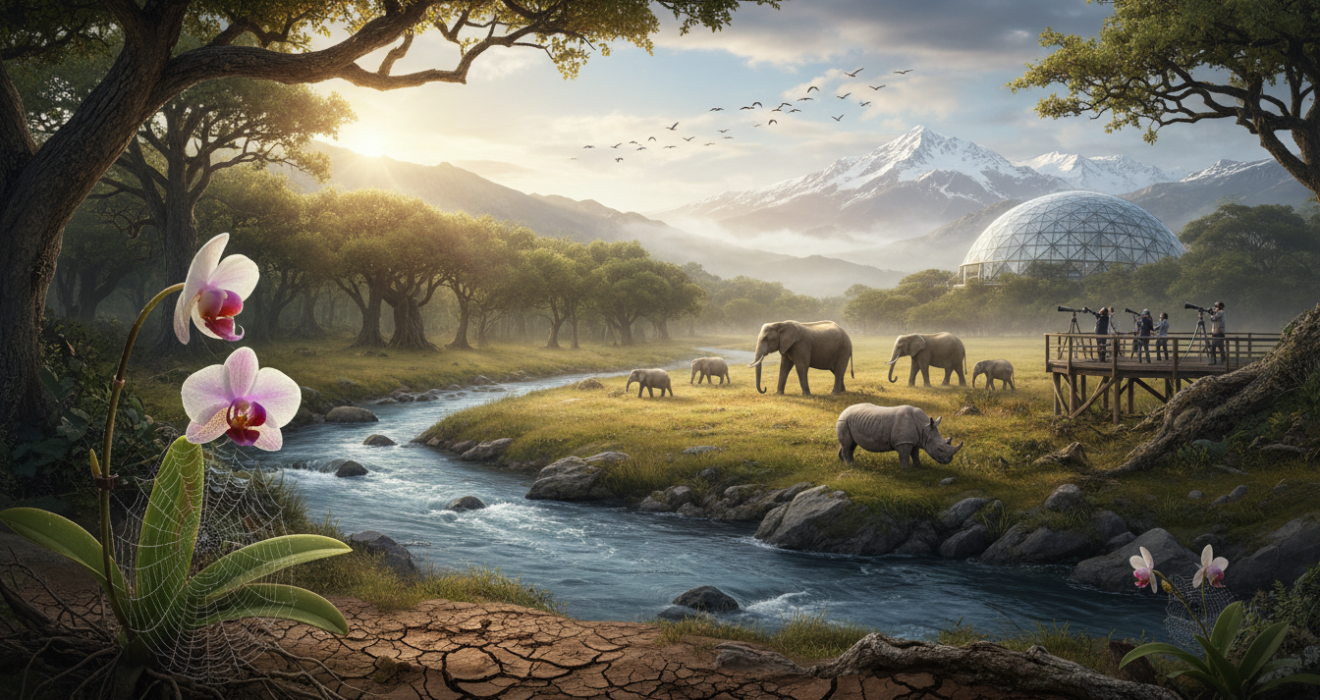
Nature Conservation: Beyond Preservation to Active Restoration
I still remember the metallic tang of fear I tasted in the back of my throat while tracking poaching snares in the distinct humidity of the Sumatran rainforest. It wasn’t the tigers I was afraid of; it was the silence. A healthy jungle is a cacophony—a riot of insects, birds, and shifting leaves with nature conservation. Silence in the wild is the loudest alarm bell you will ever hear. It signifies an ecosystem holding its breath, or worse, one that has already gasped its last.
Executive Summary
| Key Concept | Core Insight | Actionable Takeaway |
|---|---|---|
| Economic Valuation | Nature provides over $44 trillion in ecosystem services, widely ignored by traditional GDP metrics. | Support businesses that account for “Natural Capital” in their auditing. for nature conservation |
| Rewilding Dynamics | Conservation is shifting from static preservation to dynamic restoration of trophic cascades. | Advocate for connectivity corridors rather than isolated protected areas. |
| Technological Integration | Bio-acoustics, EDNA, and AI are revolutionizing how we monitor biodiversity loss. | Participate in citizen science apps like iNaturalist to contribute data. |
| Indigenous Stewardship | 80% of the world’s remaining biodiversity is located on Indigenous-managed lands. | Prioritize conservation projects that center Indigenous land rights. |
That trip, nearly a decade ago, shifted my perspective entirely. We tend to view nature conservation as a charitable act—something nice we do for the pandas and the polar bears when we have extra budget. But standing there, removing rusty wire from a game trail, I realized the math is far more brutal. We aren’t saving nature for nature’s sake. We are scrambling to save the life-support systems that keep our own economies, agricultural grids, and water supplies from collapsing.
This isn’t a brochure about recycling plastic bottles. This is a deep dissection of the mechanisms, the failures, and the radical strategies currently defining the frontline of planetary defense.
The Economic Reality of Nature Conservation
Let’s strip away the romance for a moment and look at the ledger. For too long, the environment has been treated as an infinite resource and a bottomless trash can. Economists call this an “externality.” I call it a bookkeeping error of catastrophic proportions.
According to the World Economic Forum, roughly $44 trillion of economic value generation—over half the world’s total GDP—is moderately or highly dependent on nature. When we talk about nature conservation, we are talking about risk management for the global economy. Consider the coffee in your cup. It relies on a specific climatic niche and pollinators. If the cloud forests disappear and the bees succumb to colony collapse disorder, that industry doesn’t just get more expensive; it vanishes.
Natural Capital and Ecosystem Services
I recently worked with a hydrology team in the Andes. They weren’t building dams; they were planting moss. The high-altitude páramos (moors) act as massive sponges, releasing water slowly to the cities below. The city calculated that restoring the ecosystem was one-tenth the cost of building a new water filtration plant. This is the concept of “ecosystem services” in action.
We categorize these services into four buckets:
- Provisioning: Food, fresh water, wood, and fiber.
- Regulating: Climate regulation, flood control, and disease regulation.
- Cultural: Aesthetic, spiritual, and recreational benefits.
- Supporting: Nutrient cycling and soil formation.
When nature conservation efforts fail, these services degrade. The IPBES Global Assessment Report paints a stark picture: human actions have significantly altered 75% of the land-based environment and about 66% of the marine environment. This isn’t just about losing pretty landscapes; it’s about eroding the foundation of human safety.
Rewilding: A Radical Shift in Nature Conservation
For the better part of the 20th century, conservation was about fences. We drew a line on a map, called it a National Park, kicked out the local inhabitants, and told everyone to keep off the grass. This fortress conservation model is outdated. It treats nature like a museum piece—static and separate.
Enter rewilding. This approach admits that we don’t know best. The goal of rewilding isn’t to manage nature, but to restore the processes that allow nature to manage itself. It focuses on the “Three Cs”: Cores, Corridors, and Carnivores.
The Trophic Cascade Effect
You cannot discuss modern nature conservation without referencing the wolves of Yellowstone. It’s a classic case study for a reason. When wolves were reintroduced in 1995 after a 70-year absence, the effects rippled down the food chain. The wolves checked the elk population. The elk, no longer able to graze lazily in open valleys, moved to higher ground. This allowed aspen and willow trees to regenerate along the riverbanks. The trees stabilized the banks, changing the flow of the river, and provided wood for beavers. The beavers built dams, creating ponds for fish and amphibians. The return of a single apex predator physically changed the geography of the park.
I’ve seen similar projects in the Scottish Highlands, where the debate rages over bringing back the lynx. The argument isn’t just about having cool cats in the woods; it’s about controlling deer populations that currently strip the hillsides bare, preventing forest regeneration.
Technology’s Role in Modern Nature Conservation
If you think conservation is just binoculars and notebooks, you’re living in the past. The field has gone digital. On a project in the Amazon, we utilized repurposed cell phones fitted with solar panels, rigged high in the canopy. These devices, known as “Guardians,” listen to the forest. Using AI, they can distinguish the sound of a chainsaw or a logging truck from the background noise of the jungle and send a real-time alert to rangers on the ground.
Genetics and Bio-banking
We are also seeing the rise of genetic rescue. In situations where populations are too small to survive due to inbreeding (the bottleneck effect), scientists are intervening. The IUCN Red List tracks species teetering on the brink, and for some, like the Northern White Rhino, bio-banking frozen genetic material is the only hope left. It sounds like science fiction, but it is effectively a desperate insurance policy against extinction.
The Soil Crisis: The Invisible Conservation Front
We look up at the trees, but the war is often lost beneath our feet. Soil is a living ecosystem, not dirt. A single teaspoon of healthy soil contains more microorganisms than there are people on earth. Yet, industrial agriculture—tilling, chemical bombing, and monoculture—is turning living soil into dead substrate.
I once walked a farm in Iowa that had switched to regenerative agriculture. The neighbor’s field was a dust bowl after the harvest; this farmer’s field was covered in cover crops—radish and rye. He dug up a spade of earth, and it was dark, rich, and crawling with worms. That soil retains water, sequestering carbon. If we focused nature conservation efforts on soil health alone, we could mitigate a massive chunk of our current carbon emissions.
This connection between the earth and our daily lives is often severed in urban environments. We forget that our health is mirrored in the health of the land. For those seeking to reconnect with these fundamental rhythms, I often find that the curated resources at Bliss Lifes provide excellent inspiration for integrating nature back into the modern lifestyle. It starts with awareness, but it must end in practice.
Ocean Conservation: The Blue Heart
The ocean absorbs about 30% of the carbon dioxide produced by humans, buffering the impacts of global warming. But it is nearing its saturation point. Acidification is bleaching coral reefs—the nurseries of the sea. I’ve dived on reefs that were vibrant Technicolor dreamscapes in the 90s, only to return recently to find boneyards of white calcium.
Marine Protected Areas (MPAs) are the primary tool here. The goal is to protect 30% of the ocean by 2030 (the 30×30 target). But “protection” is a loose term. Many MPAs are “paper parks,” protected in name but ravaged by industrial fishing vessels that turn off their transponders to go dark. True nature conservation in the high seas requires international enforcement and satellite monitoring, which brings us back to geopolitical will.
Community-Based Conservation (CBC)
The most significant failure of early conservation movements was the exclusion of people. You cannot protect a forest if the people living on its edge are starving. They will cut it down to survive, and frankly, I would too in their shoes.
Community-Based Conservation flips the script. It ensures that local communities derive direct economic benefit from keeping the ecosystem intact. In Namibia, communal conservancies have restored wildlife populations because the locals manage the wildlife and profit from eco-tourism. A live elephant is worth more to the village than a dead one (for ivory) or a nuisance one (that tramples crops).
Furthermore, we must acknowledge that Indigenous peoples are the original and most effective conservationists. Despite comprising less than 5% of the global population, Indigenous communities protect 80% of global biodiversity. Recognizing their land rights isn’t just a human rights issue; it is a strict nature conservation necessity.
Challenges Facing Nature Conservation Today
Despite the wins, the headwinds are gale-force. We are fighting three concurrent battles:
- Habitat Fragmentation: We have sliced the world into tiny islands of nature separated by highways and cities. Animals cannot migrate, mate, or adapt.
- Invasive Species: Global trade has homogenized the planet. Rats, cats, and cane toads decimate local flora and fauna that never evolved defenses against them.
- Climate Feedback Loops: As the Amazon burns, it releases carbon, which warms the planet, which dries the Amazon, which makes it burn more. Breaking this cycle is the challenge of our time.
Organizations like The Nature Conservancy are attempting to tackle these issues at a systemic level, buying up land to prevent fragmentation and working with corporations to alter supply chains. But the pace of destruction is currently outpacing the speed of protection.
Actionable Steps for the Individual
It is easy to feel paralyzed by the scale of the problem. “What can I do?” is a common refrain I hear after lectures. The answer isn’t just “recycle.” Here is a more aggressive personal strategy:
- Vote with your Wallet: Every dollar is a vote for the world you want. If you buy palm oil products that aren’t certified sustainable, you are funding deforestation in Indonesia.
- Rewild your Yard: The obsession with the manicured lawn is a disaster for biodiversity. Plant native species. Let the grass grow. create a pollinator strip. If every suburban lawn was half-converted to native habitat, we would create millions of acres of connectivity.
- Support Land Trusts: National NGOs are great, but local land trusts preserve the woods down the street. They are often underfunded and incredibly effective.
- Reduce Meat Consumption: You don’t have to go vegan, but the land footprint of beef is astronomical compared to plant-based proteins. Reducing intake reduces pressure on land conversion.
Future Outlook: The Anthropocene
We are living in the Anthropocene—the age of humans. There is no “pristine” nature left. Microplastics have been found in the Marianas Trench and in the ice of Antarctica. Nature conservation in this era is about damage control and active management. It is about using our god-like technology with the wisdom of a gardener, not a conqueror.
The next ten years are critical. We are identifying “tipping points”—thresholds which, once crossed, lead to irreversible collapse. The thawing of the permafrost is one. The collapse of the Amazon rainforest into a savannah is another. We are dancing on the edge of these cliffs.
Conclusion: A Shift in Consciousness
My hope lies in the shift I see in the younger generation. They understand intuitive connectivity. They see that the economy is a wholly owned subsidiary of the environment, not the other way around. Conservation is no longer about fencing off a pretty view; it is about securing the structural integrity of our home.
We must move from being consumers of nature to being custodians. It requires a humility we have lacked for centuries. As I learned in Sumatra, nature doesn’t need us to survive in the long run—it has recovered from asteroids and ice ages. But if we want to survive within it, we need to change, and we need to do it now.