
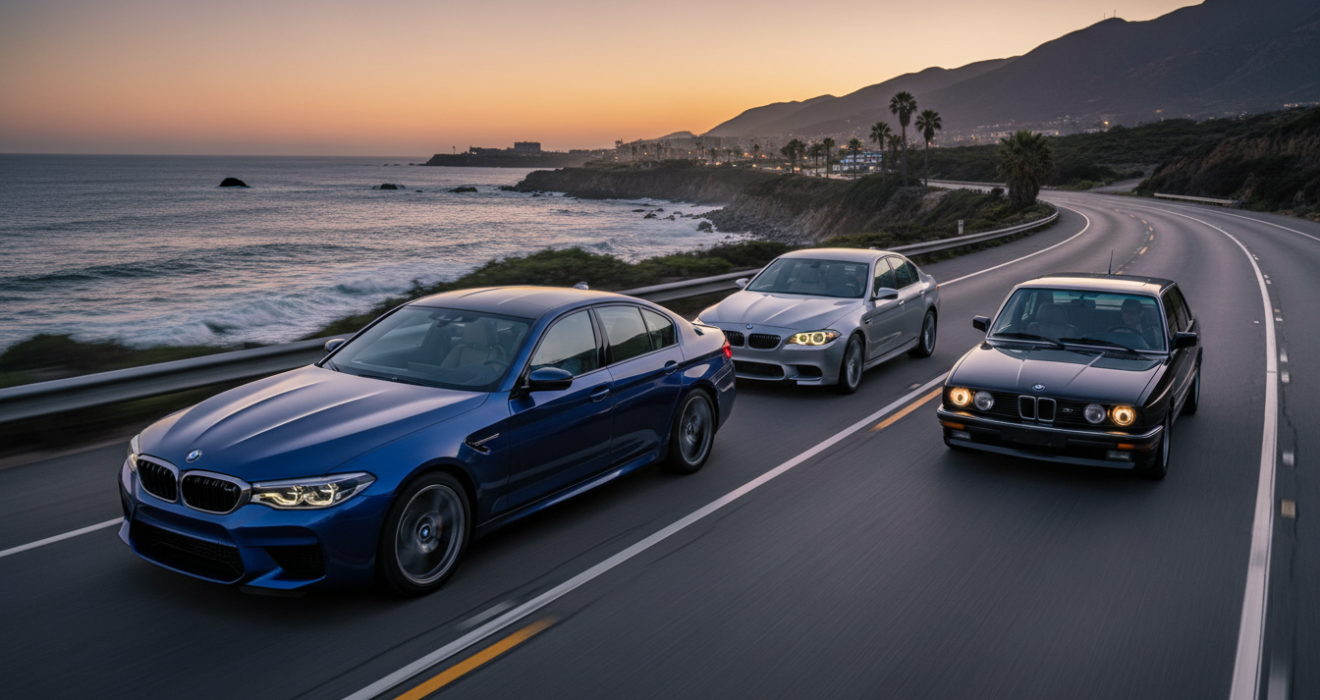
BMW M5 Review: Evolution of the Ultimate Super Sedan
There are few vehicles in the automotive pantheon that command as much respect, fear, and admiration as the BMW M5. For over four decades, this badge has represented the perfect synthesis of executive luxury and racetrack-shattering performance. As an automotive journalist who has spent countless hours behind the wheel of various M-cars—from the raw, analog feedback of the E28 to the digital precision of the F90—I can attest that the M5 is not merely a car; it is a benchmark. It is the yardstick by which all other sport sedans are measured. Furthermore, the M5 represents a philosophy: the idea that a driver should never have to compromise between comfort and adrenaline.
In this extensive analysis, we will explore the lineage, engineering marvels, and the visceral driving experience that defines the BMW M5. Whether you are a prospective buyer, a long-time owner, or an enthusiast admiring from afar, this guide offers unique insights into the machine that defined a genre. Consequently, we will also look ahead to the electrified future of the brand.
Executive Summary: The M5 at a Glance
Before we dive deep into the technical nuances and historical significance, the table below provides a quick reference guide to the current landscape of the BMW M5 ecosystem.
| Feature | Specification / Detail |
|---|---|
| Vehicle Class | High-Performance Executive Saloon (Super Sedan) |
| Current Generation | G90 (Hybrid V8) / F90 (Twin-Turbo V8) |
| Primary Competitors | Mercedes-AMG E63 S, Audi RS7, Porsche Panamera Turbo |
| Key Differentiator | Dual-personality: Track weapon and comfortable daily driver |
| Drivetrain | M xDrive (AWD with RWD capability) |
| 0-60 mph Time | Approximately 2.9 – 3.4 seconds (Depending on model) |
This duality is what makes the vehicle so compelling. Moreover, it is why the M5 remains a dream car for millions. If you are interested in exploring more about high-performance vehicles, you can browse extensive luxury car reviews and automotive insights to see how other brands stack up against this Bavarian giant. For the other information about the BME car visit this blog BMW.
The Evolution of the BMW M5
To truly appreciate the modern BMW M5, one must understand its roots. The lineage of this vehicle is a roadmap of automotive engineering progress. Each generation brought something new to the table, pushing the envelope of what was physically possible for a four-door sedan.
The E28 M5: Where It All Began
Launched in 1984, the E28 M5 was the Genesis. Hand-built by BMW Motorsport technicians, it utilized the M88/3 engine derived from the legendary M1 supercar. At the time, placing a racing engine into a subdued sedan body was unheard of. Effectively, it created the “Q-car” or “sleeper” category. Producing 282 horsepower, it was the fastest production sedan in the world at its debut. Driving an E28 today is a lesson in engagement; the steering box is communicative, and the throttle response is instantaneous. However, compared to modern standards, the chassis flex and body roll are noticeable, adding to its vintage charm.
The E39 M5: The Holy Grail
Fast forward to 1998, and the E39 M5 arrived. For many enthusiasts, myself included, this remains the high-water mark of the nameplate. It was the first M5 to feature a V8 engine—the glorious 4.9-liter S62. With 394 horsepower channeled through a mandatory 6-speed manual transmission, it was a driver’s car in the purest sense. The balance of the E39 is legendary. Furthermore, the styling was muscular yet understated, a balance that modern designers often struggle to replicate. The lack of complex electronic aids meant the driver was solely responsible for keeping the car on the tarmac, creating a bond between man and machine that is rare in today’s digitized world.
The V10 Era: E60 BMW M5
Then came the madness of the mid-2000s. The E60 M5, introduced in 2005, featured a 5.0-liter V10 engine (S85) inspired by BMW’s Formula 1 involvement. Revving to a stratospheric 8,250 RPM, this engine produced a howling 500 horsepower. When you hear an E60 M5 at full tilt, the sound is spine-tingling—a mechanical symphony that no turbocharged engine can duplicate. However, this generation was marred by the clunky SMG (Single Clutch) transmission and notorious reliability issues, specifically regarding rod bearings. Despite these flaws, the E60 remains a cult classic simply for its audacious powertrain.
F10 and F90: The Turbo Revolution
The F10 marked the transition to forced induction with the 4.4-liter Twin-Turbo V8. While it lost some acoustic drama, it gained massive torque. Subsequently, the F90 perfected this formula by introducing M xDrive, an all-wheel-drive system that allowed the car to put its power down in any weather condition. This generation transformed the BMW M5 into a sub-3-second 0-60 mph rocket, capable of embarrassing supercars at traffic lights.
Performance Engineering Behind the Ultimate Driving Machine
What makes a BMW M5 tick? It is not just about a big engine; it is about the holistic integration of chassis, suspension, and drivetrain technologies. The engineering prowess required to make a 4,000+ pound sedan handle like a sports car is immense.
Engine Dynamics and Horsepower
The heart of the modern M5 (specifically the F90 and early G90 iterations) is the S63 engine. This 4.4-liter V8 utilizes a “Hot-V” configuration, where the turbochargers are placed inside the valley of the engine block. This design significantly reduces turbo lag, ensuring that power is available the moment you graze the throttle. With outputs ranging from 600 to 627 horsepower in the CS variants, the acceleration is relentless. Furthermore, the cooling systems are over-engineered to handle track abuse, featuring multiple radiators and dedicated oil coolers.
According to data from Car and Driver, the M5 Competition has consistently outperformed its stated manufacturer figures, often hitting 60 mph in as little as 2.8 seconds during independent testing. This level of performance was previously the exclusive domain of hypercars costing ten times as much.
M xDrive System Explained
One of the most controversial yet successful additions to the BMW M5 was the M xDrive system. Purists initially balked at the idea of an all-wheel-drive M5. However, BMW engineers implemented a brilliant solution: a selectable 2WD mode. In standard 4WD mode, the system is rear-biased, sending power to the front wheels only when slip is detected. Switch it to 4WD Sport, and the car allows for controlled drifts. Finally, in 2WD mode, the front axle is completely decoupled, turning the M5 into a tire-shredding, rear-wheel-drive monster. Consequently, owners get the best of both worlds: winter traction and summer hooliganism.
Driving the BMW M5: A First-Hand Experience
Specs on a sheet are one thing; driving the car is another. I vividly remember my first time launching an F90 M5 Competition. You sit in aggressive, bolstered seats, gripping a thick, leather-wrapped steering wheel. You press the bright red M1 button on the steering wheel, which I had pre-configured for Sport Plus settings.
With one foot on the brake and the other mashing the gas, the launch control activates. Release the brake, and the violence is immediate. It doesn’t just accelerate; it teleports. The sensation is physical—your chest compresses, and your vision narrows. Yet, what is most impressive is how the car settles down immediately after. Cruising at 80 mph on the highway, the cabin is whisper-quiet. The suspension, while firm, absorbs imperfections with sophisticated damping. In addition, the steering provides enough feedback to let you know what the front tires are doing without the nervous twitchiness of a dedicated track car.
The M5 hides its weight exceptionally well. Entering a corner, the active anti-roll bars keep the body flat. You can feel the M Differential working, vectoring torque to the outside wheel to rotate the car. It defies physics. Nevertheless, you are always aware of the mass; it requires respect. If you push it too far, momentum will win, but the electronic safety nets are incredibly calibrated to catch you before disaster strikes.
Interior Luxury and Technology
The interior of a BMW M5 is a masterclass in ergonomics and material quality. It is not enough to be fast; an executive sedan must be luxurious. Merino leather covers almost every surface, and real carbon fiber or aluminum trim accents the cabin. The latest generations feature the iDrive system, widely regarded as one of the best infotainment interfaces in the industry.
The Digital Cockpit
The driver faces a fully digital instrument cluster that changes based on the selected drive mode. In ‘Track’ mode, non-essential information fades away, leaving a large tachometer and gear indicator. The Head-Up Display (HUD) is massive, projecting speed, navigation, and shift lights directly onto the windshield. This allows the driver to keep their eyes on the road at all times. Moreover, the connectivity features are top-tier, including wireless Apple CarPlay and Android Auto.
Seating comfort is another highlight. The M Multifunction seats offer heating, ventilation, and massage functions. They are adjustable in nearly every dimension, including the width of the side bolsters. Whether you are attacking a canyon road or stuck in rush-hour traffic, the M5 keeps you comfortable. For those interested in how these features compare to other market offerings, visiting reliable automotive hubs like BMW M Official can provide deeper insights into the specific configuration options available.
Maintenance and Ownership Costs of a BMW M5
Owning a BMW M5 is a financial commitment that extends far beyond the purchase price. As with any high-performance German machine, maintenance is critical. Neglecting service intervals can lead to catastrophic failures. For the V10 E60 generation, rod bearing replacement is almost considered a routine maintenance item every 60,000 miles, a job that can cost thousands of dollars.
Common Wear Items
The F90 generation is generally more reliable, but it still has an appetite for consumables. Tires, specifically Michelin Pilot Sport 4S, are expensive and, given the car’s weight and power, do not last long if driven aggressively. Brakes are another major expense. If the vehicle is equipped with carbon-ceramic brakes, they offer immense stopping power and longevity on the track, but replacement rotors can cost as much as a used economy car. Furthermore, fuel consumption is heavy. While highway cruising can yield decent MPG, spirited driving will drain the tank rapidly.
It is also worth noting that insurance premiums for a BMW M5 are significantly higher than for a standard 5 Series. Insurers view these vehicles as high-risk due to their performance capabilities. Therefore, prospective buyers should obtain insurance quotes prior to purchase. Checking resources like the NHTSA for safety ratings and recall information is also a prudent step in the due diligence process.
Competitor Landscape
The BMW M5 does not exist in a vacuum. Its primary rival has always been the Mercedes-AMG E63 S. Historically, the AMG has been the “muscle car” of the duo—louder, smokier, and slightly less precise. The M5 has traditionally been the surgeon’s scalpel to the AMG’s sledgehammer. However, in recent years, the lines have blurred. The AMG has become more precise, and the M5 has gained more torque.
The Audi RS7 (and RS6 Avant) offers a different appeal. With its Quattro system, the Audi is often seen as the best all-weather daily driver, though it sometimes lacks the dynamic engagement of the M5’s rear-biased chassis. Then there is the Porsche Panamera Turbo. While dynamically brilliant, the Porsche commands a significantly higher price point and offers less interior space. Ultimately, the choice often comes down to brand loyalty and subjective styling preferences.
Future Outlook: Hybridization and the G90
The automotive world is changing, and the BMW M5 is adapting. The upcoming G90 generation introduces a plug-in hybrid powertrain. This move is controversial among purists who fear the added weight of batteries. However, electrification offers immediate torque fill and the ability to drive in zero-emission zones in city centers.
This transition suggests that the M5 will continue to survive as environmental regulations tighten. The challenge for BMW M engineers will be to mask the increased mass and ensure the car retains its agile character. If history is any indicator, they will likely succeed. The integration of electric motors typically results in even faster 0-60 times, suggesting the next M5 will be the quickest yet.
Conclusion
The BMW M5 remains the definitive super sedan. It is a car that asks for no compromises, delivering supercar performance with limousine luxury. From the hand-built origins of the E28 to the high-tech wizardry of the F90 and G90, the M5 has constantly evolved while staying true to its core mission: being the Ultimate Driving Machine. For the enthusiast who needs one car to do it all—school runs, business meetings, and track days—there is arguably no better choice. It is a piece of automotive history that you can drive every day.
Frequently Asked Questions (FAQ)
1. Is the BMW M5 a reliable daily driver?
Yes, the modern BMW M5 (F90 generation) is surprisingly reliable for a high-performance car. However, it requires strict adherence to maintenance schedules. Older generations, particularly the E60 V10, are known to be temperamental and require a specialized maintenance budget.
2. What is the difference between the M5 and M5 Competition?
The Competition package usually adds a slight horsepower bump (typically 17-25 hp), stiffer engine mounts, a retuned suspension for sharper handling, a louder exhaust system, and unique cosmetic details like black badging and wheels.
3. Can the BMW M5 be driven in snow?
Absolutely. The modern M5 features the M xDrive all-wheel-drive system. When equipped with proper winter tires, it is an incredibly capable machine in snowy conditions. Rear-wheel-drive models (older generations) are more challenging in winter but manageable with good tires.
4. How much does a BMW M5 cost to maintain?
Owners should budget significantly more than a standard sedan. An annual budget of $2,000 to $4,000 is reasonable for routine maintenance (tires, oil, brakes) on a modern M5, while older models out of warranty may require a larger “repair fund” for unexpected issues.
5. Which BMW M5 generation is the best investment?
The E39 M5 is currently seeing a steady appreciation in value due to its analog nature, manual transmission, and V8 engine. It is widely considered a modern classic. The E28 is also highly collectible but much rarer.