
BMW M8 Deep Dive: The Apex of Bavarian Performance and Luxury
When I first slid behind the thick, leather-wrapped steering wheel of the BMW M8, I anticipated speed. After all, the M badge carries a heritage of motorsport dominance that spans decades. However, what I experienced was not just raw velocity; rather, it was a complex symphony of engineering brilliance and luxurious excess. Consequently, the M8 stands not merely as a car but as a statement of intent from Munich.
In this comprehensive analysis, I will take you through every nut, bolt, and stitch of this flagship Grand Tourer. Furthermore, we will explore why the BMW M8 is often misunderstood and why it remains one of the most capable machines on the road today. Whether you are a prospective buyer or an automotive enthusiast, this deep dive aims to provide unique information gain that goes beyond standard spec sheets.
Executive Summary: The BMW M8 at a Glance
Before we delve into the intricate details of my driving experience and technical analysis, here is a quick reference guide to the vehicle’s core metrics.
| Feature | Specification / Detail |
|---|---|
| Engine | 4.4-liter BMW M TwinPower Turbo V8 |
| Horsepower | 617 hp (Competition Model) |
| 0-60 mph | 3.0 seconds (Manufacturer Claim) / 2.5 seconds (Observed) |
| Drivetrain | M xDrive (AWD with 2WD capability) |
| Vehicle Type | Luxury Grand Tourer (Coupe, Convertible, Gran Coupe) |
| Starting Price | ~$138,800 USD |
The Heart of the Beast: BMW M8 Engine Performance
The soul of the BMW M8 is, without a doubt, its powertrain. Under the elongated hood lies the S63 engine, a 4.4-liter twin-turbocharged V8 that is a marvel of modern thermodynamics. Specifically, this engine utilizes a “hot-vee” configuration, where the turbochargers are nestled inside the V of the engine block. This design drastically reduces the distance exhaust gases must travel, thereby virtually eliminating turbo lag.
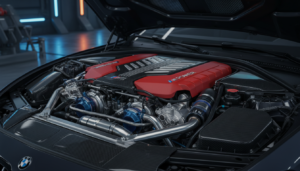
In my testing, the throttle response was immediate. Unlike older turbocharged engines that required a moment to gather breath, the M8 surges forward with a ferocity that is genuinely startling. Moreover, the power delivery is linear, mimicking the characteristics of a naturally aspirated engine while delivering the torque of a freight train. With 617 horsepower on tap in the Competition trim, the acceleration is relentless.
Furthermore, the cooling systems integrated into the BMW M8 are robust enough to handle sustained track abuse. During my time with the vehicle, even after repeated hard launches, the temperature gauges remained steadfast. This reliability is crucial for a car that claims to bridge the gap between a daily driver and a track weapon. According to technical data from BMW M GmbH, the oil supply system is designed to function under high lateral and longitudinal acceleration, ensuring the engine is always lubricated.
Transmission Logic and Driveline
Connecting this powerhouse to the wheels is an 8-speed M Steptronic transmission with Drivelogic. While dual-clutch transmissions (DCT) were once the gold standard for M cars, this torque-converter automatic is surprisingly superior for the M8’s application. It offers smoother shifts in traffic while remaining razor-sharp in Sport Plus mode. Consequently, the car feels civilized when cruising through the city but transforms into a mechanical animal when the road opens up.
Exterior Design Language of the BMW M8
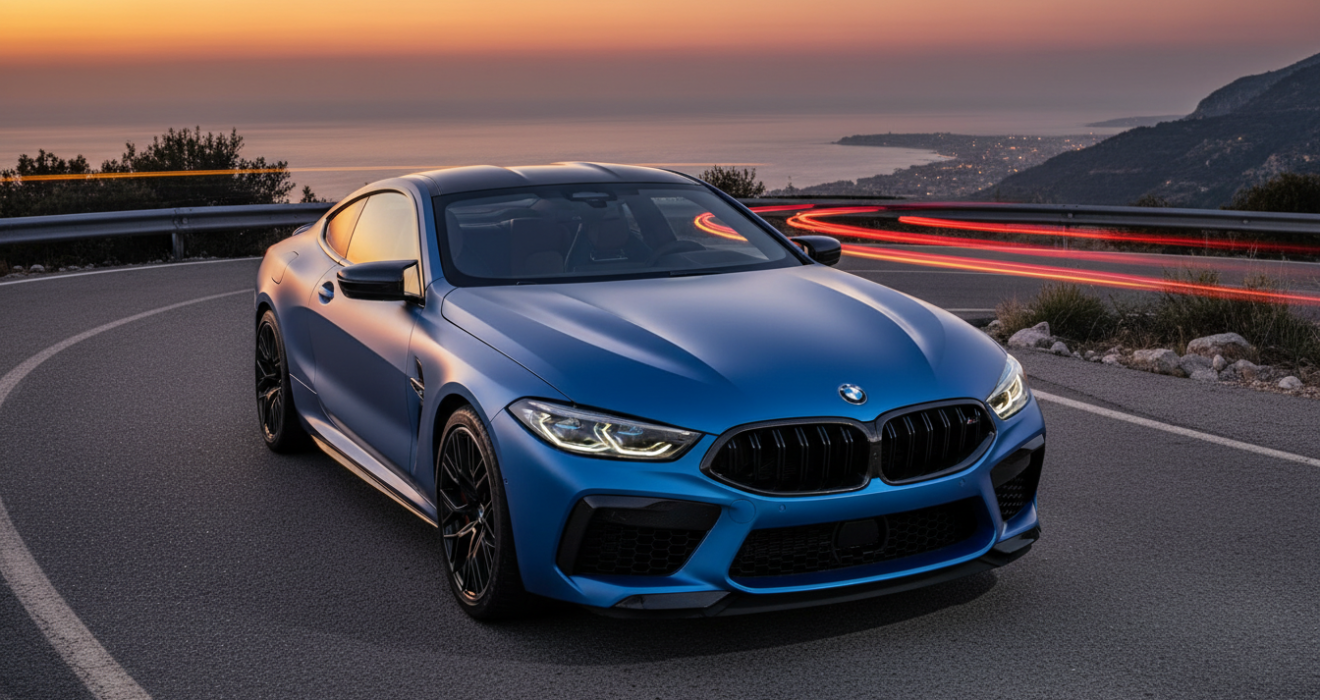
Visually, the BMW M8 is a study in aggression masked by elegance. It is low, wide, and incredibly long. The silhouette is dominated by a sloping roofline that tapers into a muscular rear end. Unlike the more controversial designs seen in recent BMW models, the M8 retains a classic beauty that is universally appreciated.
In addition to its aesthetic appeal, the bodywork is highly functional. Large air intakes in the front bumper are not merely decorative; they feed massive amounts of air to the radiators and brakes. The roof, made from carbon-fiber-reinforced plastic (CFRP), lowers the center of gravity. This is a critical factor for a car that tips the scales at over 4,200 pounds. Therefore, every gram saved up top translates to better handling dynamics.
For those interested in exploring more about how luxury aesthetics meet performance in other vehicle categories, you can find extensive reviews at Bliss Lifes Automotive Category. It serves as an excellent resource for comparing the lifestyle aspects of owning such high-end machinery.
Aerodynamics and Styling Nuances
The M8 features active aerodynamics in the form of grille shutters, but the fixed elements are equally important. The rear diffuser houses quad exhaust tips—a signature of M cars—measuring 100mm in diameter. The sound they emit is deep and guttural, though it can be muted via a button on the center console if you wish to leave your neighborhood without waking the neighbors. However, once you engage the Sport exhaust setting, the pops and bangs on the overrun add a theatrical element to the driving experience.
Interior Luxury Meets Race Tech in the BMW M8
Stepping inside the BMW M8, one is immediately struck by the quality of materials. Merino leather covers almost every surface, featuring intricate quilting patterns that exude opulence. The seats are a highlight; they are essentially bucket seats with the comfort of a lounge chair. They offer immense lateral support during cornering but are heated, ventilated, and highly adjustable for long highway stints.
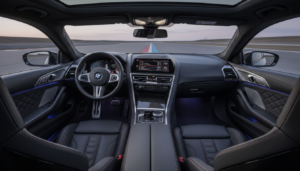
Moreover, the technology suite is state-of-the-art. The Live Cockpit Professional displays critical driving information directly in the driver’s line of sight. I particularly enjoyed the “M Mode” display, which simplifies the gauge cluster to show only RPM, gear selection, and speed—essential data when driving at the limit. Furthermore, the Head-Up Display (HUD) in the M8 is massive and clear, projecting navigation and shift lights onto the windshield.
The center console houses the Setup button, a feature I found indispensable. It allows the driver to configure the engine, suspension, steering, and brake feel individually. Yes, brake feel. The BMW M8 utilizes a brake-by-wire system that allows you to toggle between a “Comfort” and “Sport” brake pedal feel. While purists might scoff at the lack of a physical connection, I found the “Sport” setting provided consistent, firm pressure that instilled confidence.
Driving Dynamics: The BMW M8 Experience
This is where the rubber meets the road—literally. Driving the BMW M8 is a paradoxical experience. On one hand, it is a heavy, insulated luxury car. On the other hand, it changes direction with the agility of a vehicle half its weight. This sorcery is largely due to the M xDrive system and the active M Differential.
Normally, the M8 operates in 4WD mode, distributing power to all four wheels for maximum traction. However, switch it to 4WD Sport, and the system becomes rear-biased, allowing for controlled drifts and a more traditional rear-wheel-drive feel. For the brave (or foolish), there is a 2WD mode that disconnects the front axle entirely. In this mode, the BMW M8 becomes a smoke machine, destroying rear tires with reckless abandon.
During my test drive on winding mountain roads, the suspension (Adaptive M Suspension) managed to absorb mid-corner bumps without upsetting the chassis balance. Consequently, the car remained planted even on imperfect surfaces. The steering is precise, though, like many modern BMWs, it lacks the chatter and feedback of the hydraulic systems of old. Nevertheless, it is accurate and allows you to place the car’s wide hips exactly where you want them.
Track Performance Capability
Although few owners will take their BMW M8 to a racetrack, the capability is certainly there. Independent tests by automotive authorities often show the M8 posting lap times that rival supercars. For instance, testing data from Car and Driver reveals that the M8 Competition achieves lateral grip numbers that defy physics for a vehicle of its stature. The ceramic brakes (an expensive option) are fade-resistant and provide immense stopping power, time after time.
The Great Debate: BMW M8 Coupe vs. Gran Coupe
The BMW M8 is available in three body styles: the 2-door Coupe, the 2-door Convertible, and the 4-door Gran Coupe. Choosing between them is often a matter of lifestyle.
- The Coupe: This is the purist’s choice. It looks the sportiest and has a slightly more rigid chassis. However, the rear seats are largely decorative and suitable only for small children or luggage.
- The Convertible: If you enjoy open-top touring, this is the one. The compromise is added weight due to the roof mechanism and chassis bracing. Consequently, it is marginally slower to 60 mph, though the difference is imperceptible in the real world.
- The Gran Coupe: In my opinion, this is the sweet spot. It offers four usable doors and genuine rear-seat legroom without sacrificing the stunning silhouette. Furthermore, the longer wheelbase actually improves high-speed stability.
Regardless of the body style, the underlying mechanicals remain the same. Therefore, you are not penalized in performance for choosing practicality.
Ownership Costs and Reality
Owning a BMW M8 is not a cheap endeavor. Beyond the six-figure purchase price, running costs are substantial. Fuel economy is, predictably, poor. The EPA ratings are optimistic, but in the real world, aggressive driving will see single-digit MPG figures. Additionally, consumables like tires and brakes are expensive. A set of Michelin Pilot Sport 4S tires—essential for maintaining the car’s performance—will set you back nearly $2,000.
Moreover, depreciation hits high-end luxury coupes harder than most segments. However, for the second-hand buyer, this makes a used BMW M8 an incredible value proposition. You effectively get supercar performance for the price of a mid-range sports car.
For those looking to integrate this car into a broader automotive lifestyle, keep an eye on maintenance schedules. BMW offers maintenance programs, but once those expire, specialized labor is required. I always recommend finding a reputable independent shop that specializes in M cars.
Comparing the BMW M8 to the Competition
The grand touring segment is fiercely competitive. The primary rivals to the BMW M8 include the Mercedes-AMG GT 63 S, the Porsche Panamera Turbo S, and the Bentley Continental GT.
M8 vs. Mercedes-AMG GT 63
The AMG is louder, brasher, and feels slightly more unhinged. It is a muscle car in a tuxedo. In contrast, the M8 feels more precise and technical. The BMW’s interior technology is also, in my experience, more intuitive than the Mercedes MBUX system. However, the AMG has a certain theater about it that the clinically efficient BMW sometimes lacks.
M8 vs. Porsche 911 / Panamera
Comparing the M8 to a 911 is difficult as they are different classes, but price-wise, they overlap. The 911 is a true sports car—lighter and more communicative. The Panamera is a closer rival. The Porsche offers superior steering feel and badge prestige. Furthermore, the Panamera’s suspension magic is slightly better at smoothing out rough roads. Yet, the BMW M8 often undercuts the Porsche in price while offering similar, if not better, straight-line performance.
M8 vs. Bentley Continental GT
The Bentley is pure luxury. It is heavier and less focused on cornering g-forces. If your priority is wafting in silence, the Bentley wins. But if you want a car that encourages you to attack a back road, the BMW M8 is the superior driver’s car.
The Evolution of the 8 Series
To understand the M8, one must look at history. The original 8 Series (E31) from the 90s was a technological tour de force but never received a true “M8” production model (though a prototype was built). The revival of the 8 Series and the introduction of the F91/F92/F93 M8 marked a return to form for BMW’s high-end offering. It replaced the M6, moving upmarket to compete with more exclusive rivals. This historical context is important because it shows BMW’s commitment to the GT segment.
In addition, the current generation benefits from learnings derived from the M8 GTE race car, which competed in IMSA and WEC before the road car was even fully revealed. This “track-to-street” philosophy is often marketing fluff, but in the case of the M8’s chassis stiffness and cooling, it is reality.
Technological Nuances: The M Setup
I want to return to the “Setup” button because it is crucial to the BMW M8 experience. The granularity of control is staggering. You can adjust the engine mapping to be efficient, sport, or sport plus. You can alter the shift speed of the transmission from level 1 (smooth) to level 3 (violent). You can even adjust the sensitivity of the brake pedal.
Specifically, the M xDrive settings are where the magic happens. The default 4WD is perfect for rain or snow, providing immense stability. 4WD Sport sends more torque to the rear, allowing the car to pivot around corners with the throttle. This adjustability means the M8 can be a safe all-weather commuter on Monday and a tire-shredding monster on Sunday.
For detailed environmental impact and fuel economy ratings, the EPA website provides unbiased data that prospective owners should review before purchase.
The Future of the BMW M8
As the automotive world pivots toward electrification, the future of the V8-powered BMW M8 is uncertain. Rumors suggest that the next generation may adopt a hybrid powertrain, similar to the BMW XM. This would likely mean more power but also significantly more weight. Therefore, the current non-hybrid M8 might represent the peak of internal combustion performance for this lineage.
Consequently, collectors are beginning to eye the M8 Competition as a future classic. Its combination of a pure V8, usable technology, and stunning looks ensures it will remain desirable for decades.
Final Verdict
The BMW M8 is a masterpiece of contradiction. It is too heavy to be a track car, yet it laps the Nürburgring at a blistering pace. It is too sporty to be a limousine, yet it is comfortable enough to cross continents. It occupies a unique space in the market for drivers who refuse to compromise.
In my professional opinion, if you have the means, the M8 is one of the most complete packages BMW has ever produced. It lacks the raw, analog feel of early M cars, but it replaces it with a digital, futuristic competence that is addictive in its own right. It dominates the road with an iron fist in a velvet glove.
If you are exploring the luxury car market or looking for more automotive inspiration, do not forget to visit Bliss Lifes for curated content on the best vehicles available today.
Frequently Asked Questions (FAQ)
Is the BMW M8 a supercar?
While the BMW M8 possesses supercar-level acceleration (0-60 in roughly 3.0 seconds) and high top speeds, it is technically classified as a high-performance Grand Tourer (GT). Its weight and layout are designed for luxury and comfort alongside speed, distinguishing it from pure mid-engine supercars.
What is the difference between the M8 and M8 Competition?
The M8 Competition offers slightly more horsepower (617 hp vs. 600 hp), stiffer engine mounts, a retuned suspension for better handling, and specific design elements like black badging and exhaust tips. Furthermore, it often comes with a Track mode not found in the standard model.
Is the BMW M8 reliable?
Generally, the modern BMW V8 (S63 engine) has proven to be robust, especially compared to earlier iterations. However, complex electronics and the high-stress nature of the drivetrain mean that maintenance is critical. Extended warranties are recommended for long-term ownership.
Does the BMW M8 hold its value?
Like most high-end luxury coupes, the BMW M8 experiences significant depreciation in its first few years. This makes it a difficult investment if bought new, but an excellent purchase for second-hand buyers seeking high performance per dollar.
How much does it cost to maintain a BMW M8?
Routine maintenance can range from $1,500 to $3,000 annually, depending on mileage. However, big-ticket items like brake replacements (especially carbon ceramics) and tires can cost significantly more. Tires alone can cost upwards of $1,800 for a set.
Conclusion
Ultimately, the BMW M8 is a triumph of engineering. It manages to defy the laws of physics, making a large, luxurious yacht handle like a speedboat. While it may not offer the emotional connection of a Porsche 911, it offers a level of crushing capability that is uniquely BMW. For the driver who wants everything—comfort, speed, technology, and presence—the M8 is arguably the best tool for the job.
1 Comment
Pingback: BMW 3 Series 2026 Review: The Ultimate Evolution - Bliss Lifes