

Horsepower to High-Tech: The Evolution of Automobile History
Human transportation has undergone massive shifts throughout history, yet few inventions have reshaped society as profoundly as the car. Indeed, the journey from horse-drawn carriages to autonomous electric vehicles is a story of relentless innovation. Specifically, the evolution of automobile technology marks a pivotal transition from simple mechanical curiosity to the sophisticated computing power we see on roads today. Furthermore, this progression has not only altered how we move but also how we design cities and structure our daily lives.
The Dawn of the Motor Car
To understand the present, we must look back to the late 19th century. Initially, steam power dominated the landscape of heavy machinery. However, it was not suitable for personal transport due to its bulk and long startup times. Consequently, inventors began seeking more efficient alternatives.
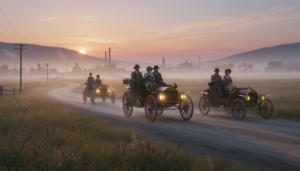
In 1886, Karl Benz patented the Benz Patent-Motorwagen, which is generally regarded as the first modern car. Unlike its predecessors, this vehicle utilized an internal combustion engine. Moreover, this invention signaled the beginning of a new era. Although these early models were expensive and unreliable, they laid the groundwork for future engineering. Subsequently, the evolution of automobile design began to accelerate as more engineers entered the race to build faster and more reliable vehicles.
Mass Production and the Assembly Line
While Benz invented the car, Henry Ford revolutionized how it was made. Before the introduction of the Model T, cars were hand-crafted luxuries reserved for the wealthy. In contrast, Ford believed that automobiles should be accessible to the general public.
The Model T Revolution
In 1908, the Model T was introduced, but the true breakthrough came in 1913 with the implementation of the moving assembly line. As a result, production times dropped continuously, and costs plummeted. Therefore, the automobile became a fixture in middle-class driveways rather than just a toy for the elite. Additionally, this era defined the basic layout of cars for decades to come: a steering wheel on the left, an engine in the front, and power driven to the rear wheels.
Post-War Power and Style
Following World War II, the global economy boomed, and the automotive industry followed suit. Specifically, manufacturers began to focus on aesthetics, speed, and comfort. During the 1950s and 1960s, cars became symbols of freedom and status.
Designers introduced tailfins, chrome accents, and massive V8 engines. Furthermore, the American muscle car era pushed the limits of horsepower. However, this period often prioritized style over safety or fuel efficiency. Nevertheless, the evolution of automobile culture during these decades cemented the car’s place as a central component of modern identity.
The Efficiency and Safety Era
The 1970s brought a significant reality check in the form of the oil crisis. Suddenly, fuel economy was no longer an afterthought; it was a necessity. Consequently, the industry had to pivot rapidly. Huge engines were replaced by smaller, more efficient designs, and front-wheel drive became common to save weight and space.
Simultaneously, public awareness regarding accident fatalities grew. In response, governments mandated stricter safety standards. For instance, crumple zones, seat belts, and eventually airbags became standard requirements. Therefore, the evolution of automobile safety features became just as important as engine performance. This period proved that the industry could adapt to external pressures while continuing to innovate.
The Digital Turn: Computers on Wheels
As the 20th century drew to a close, a new player entered the automotive space: the computer. Previously, cars were purely mechanical entities. In addition, mechanics fixed cars with wrenches and screwdrivers. However, by the 1980s and 1990s, Electronic Control Units (ECUs) began managing engine timing, fuel injection, and emissions.
Today, a modern vehicle is essentially a computer network on wheels. Features like Anti-lock Braking Systems (ABS), traction control, and infotainment systems rely entirely on digital processing. Moreover, the evolution of automobile manufacturing has integrated robotics and AI to ensure precision that human hands could never achieve.

The Future: Electrification and Autonomy
Currently, we are witnessing the most significant disruption since the assembly line. Specifically, the internal combustion engine is slowly being phased out in favor of electric powertrains. Companies like Tesla have forced legacy manufacturers to accelerate their electric vehicle (EV) programs.
Furthermore, the dream of self-driving cars is becoming a reality. Sensors, cameras, and artificial intelligence allow vehicles to navigate complex environments without human intervention. Consequently, the evolution of automobile transport is moving toward a service-based model, where ownership might become secondary to mobility on demand.
Frequently Asked Questions
Who is credited with inventing the first car?
Karl Benz is widely credited with inventing the first modern automobile in 1886. However, earlier steam-powered vehicles existed, though they were not practical for daily use.
How did the assembly line change the automobile industry?
The assembly line, refined by Henry Ford, drastically reduced the time and cost required to build a car. Consequently, automobiles transformed from luxury items into accessible tools for the masses.
What is the biggest recent trend in the evolution of automobile engineering?
The shift toward electrification and autonomous driving systems is currently the most significant trend. In addition, the integration of advanced software and connectivity is redefining what a car can do.
Why did the focus shift from horsepower to efficiency in the 1970s?
The 1970s oil crisis caused fuel prices to skyrocket. As a result, consumers and regulators demanded vehicles that consumed less fuel, forcing manufacturers to prioritize efficiency over raw power.
How does the evolution of automobile safety impact modern drivers?
Modern drivers are safer than ever due to innovations like crumple zones, airbags, and active driver-assist systems. Furthermore, these technologies work continuously to prevent accidents before they happen.
Conclusion
From the rudimentary steam engines of the past to the high-tech electric vehicles of the future, the car has never stopped changing. Indeed, the history of the car is a reflection of human ingenuity and our desire for freedom. Throughout the decades, we moved from open carriages to safety-focused steel cages, and now to software-defined mobility pods.
Ultimately, the evolution of automobile technology is far from over. As we look ahead, environmental concerns and digital connectivity will continue to drive changes in how we build and drive cars. Therefore, the next chapter of this story promises to be just as exciting as the first.